
Navigate Function First

A functional behavioral assessment your team helps build - and can run again next time.
The Navigators is for school teams who have reinvented their FBA evaluation process and forms countless times, but still struggle conducting consistently valid assessments. We contribute structure, analysis, and expert review of every evaluation. Your team contributes the local knowledge and the direct observation, because the people in your building every day have access to context no outside evaluator ever gets in a few hours onsite. The evaluation runs about twenty-five school days and your team finishes it able to do more themselves.
Not looking for help with FBAs?
“I’ve taken so many FBA trainings over the years ... it wasn’t until I worked with you that it finally made sense.”
“Great advice and I feel supported.”
“Difficult meetings have been manageable due to you all.”
An FBA That Leaves Nothing Behind Isn't Worth What You Paid
When a student's behavior has persisted through everything a team has already tried, the useful question is usually not which intervention to try next. It is what the behavior is accomplishing, and under what conditions. Answering that well takes about twenty-five school days of real elapsed time: observation across conditions, honest input from the adults who know the student, and data that was not collected in one frantic week.
Most districts are responsible for that work without enough capacity to do it comfortably. The staff who could run a rigorous evaluation are already carrying re-evaluations with statutory deadlines, meetings, and crisis response. So the evaluation either runs late, or it gets handed to someone outside who produces a technically sound document at a distance from the building. Both are defensible. Neither leaves the team any better positioned the next time a different student presents differently, which is the part that compounds.
How a Co-Implemented FBA Actually Works
We do not remove the school team from the evaluation and return a report created at a distance. The Navigators is designed for teams willing to contribute their local knowledge and complete agreed-upon data-collection responsibilities while our team provides structure, analysis, and behavioral expertise. Your legal obligations stay exactly where they are; we work inside your process rather than around it.
-
You submit a referral. We review it, confirm whether the case and the timeline are workable, and tell you either way. That conversation is short and it is honest; a case that arrives with three weeks before a scheduled meeting is a case we will decline rather than rush.
-
Your Navigator reviews records and existing behavioral data, summarizes the indirect assessment, and drafts operational descriptions for the target and replacement behaviors. A behavior analyst reviews that work before anyone observes anything, because a vague description cannot be recovered from later in the process. Your Navigator then hosts a kickoff meeting with your team to review the descriptions and launch data collection.
-
Your Navigator builds the direct observation forms and sets them up in the tracking system, and a behavior analyst verifies them before they go out. Your team then collects the data: your staff, in your building, with the students and adults they already know. This is the part of the design people ask about most, and it is deliberate rather than a cost-saving measure. The contextual knowledge stays where it already is, and your people build the skill by doing the work.
-
Your Navigator analyzes everything collected across the evaluation, derives the function, and develops function-based recommendations. A behavior analyst reviews the completed assessment before it reaches your team. Then a final team meeting, and the completed FBA comes to you with the recommendations built in and resources your team can use to design intervention.
-
We email to ask how it is going, and schedule a half-hour conversation if you want one. The assessment itself does not change at that point, but we can talk through what has come up since, and what to adjust in practice.
Timeline:
About twenty-five school days. Observation across conditions and honest input from the adults who know the student do not compress. It can run longer. It cannot run shorter.
What your team does:
Designate one contact to keep the process moving
Attend two meetings
Participate in an interview about the student you already know
Complete guided direct behavior observations
Enter data in the tracking system
Design and implement intervention
What we do:
Review records, existing behavioral data, indirect assessment
Draft operational descriptions
Build the direct observation forms, set up the tracking system
Analyze the converging evidence, derive the function
Develop function-based recommendations
Ensure technical adequacy


Building Possibility Together
School teams gain…
A defensible functional hypothesis the team helped build, rather than one they received
Function-based recommendations that arrive as part of the assessment, built with the people who will implement them
Operational descriptions precise enough that different observers count the same thing
A repeatable process the team has now run once with structure around it
Stronger collaboration across the adults involved in one student's case
Students benefit from…
Intervention aligned to what their behavior is actually accomplishing
Adults working from a shared understanding rather than five interpretations
Conditions adjusted around them rather than consequences applied to them
Increased access to meaningful educational opportunity
Free resources you can use with your team right now.
Districts reach out asking how to raise the quality of functional behavior assessment across their schools, and the honest answer depends on what their assessments look like right now. So these are the two things we send first. Both are free, and neither one requires a conversation with us.
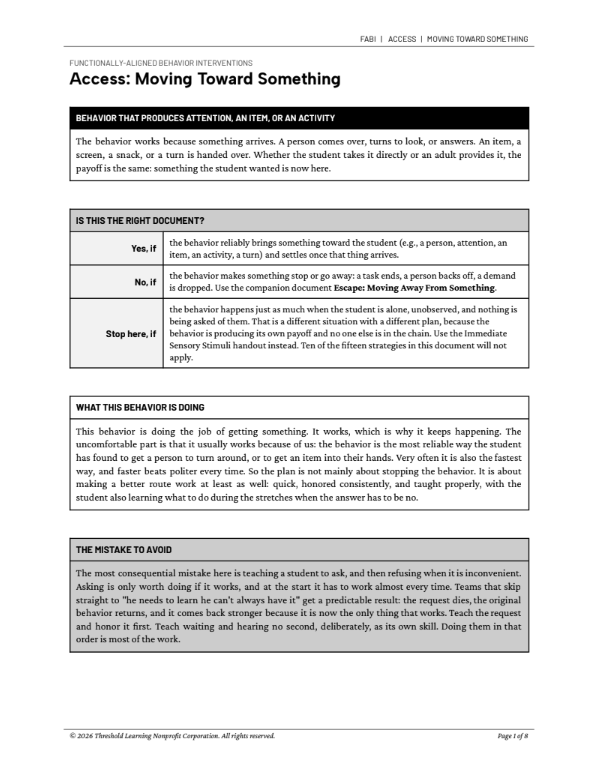
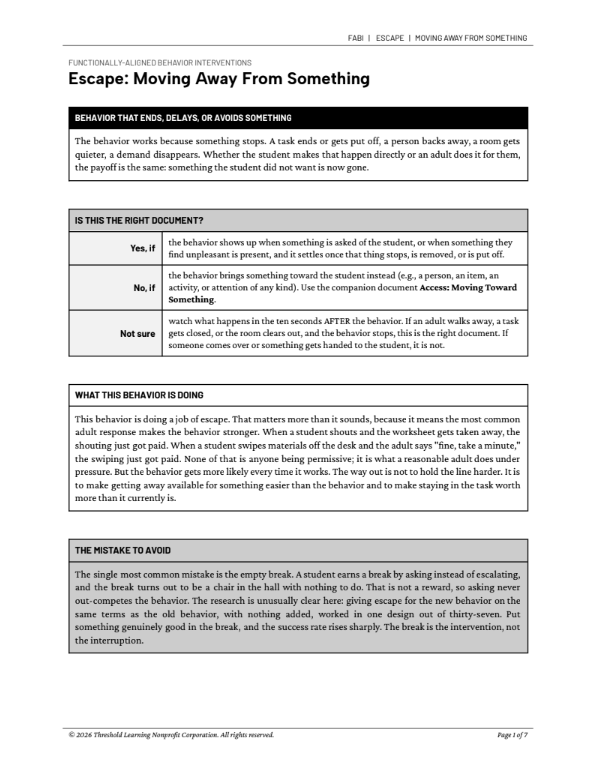
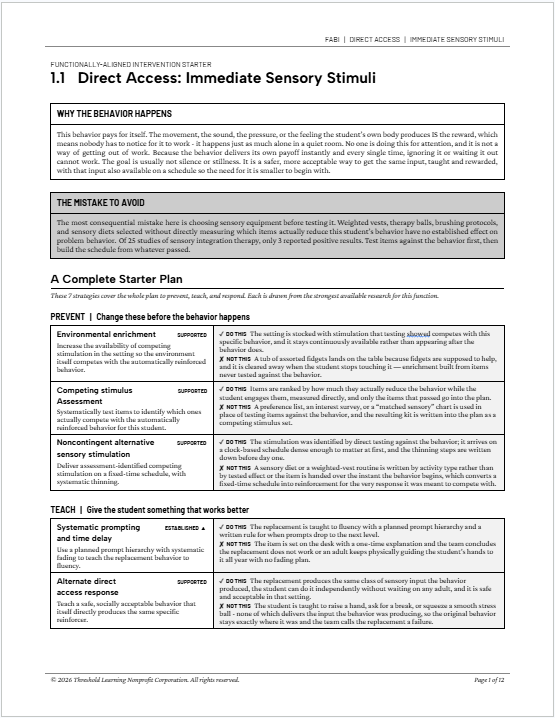
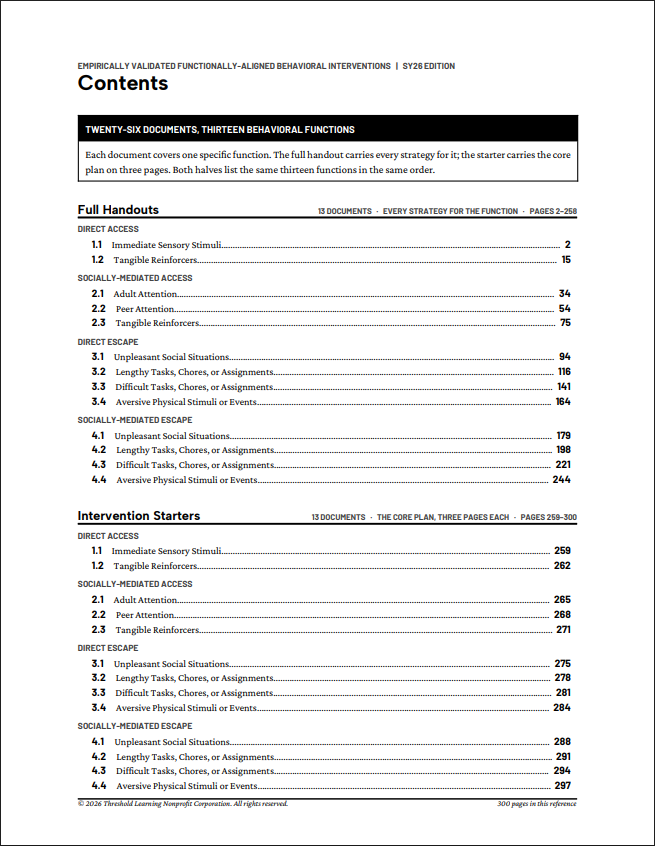
Function-aligned intervention guides. One for behavior maintained by access, one for behavior maintained by escape. Strategies are organized by function and written plainly enough to use in a behavior plan you have to write tomorrow, which is usually the real constraint.
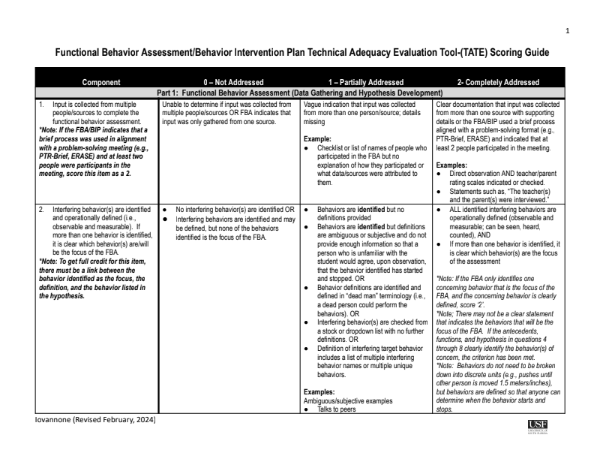
Technical Adequacy Evaluation Tool. This is the instrument we use to score every FBA completed through our work. Run it on an evaluation your district already completed. In under half an hour you will have a scored, specific picture of where that assessment is sound and where it is thin.
These are most useful to districts that already have people conducting FBAs and want a clearer read on the quality of that work. Enter your email and we will send both files. No cost, no call, no follow-up.

Who this works for - and who it doesn’t.

This is likely the right fit for your team if . . .
You have a student whose behavior has persisted through what your team has already tried
You have at least twenty-five school days before the decision that depends on this evaluation
Your staff can complete agreed-upon data collection and attend collaborative team meetings
You want your team to finish the process more capable of running the next one
You are working without enough internal behavioral capacity to run rigorous evaluations alongside everything else your staff is carrying

This isn’t the right fit if you’re looking for . . .
An evaluation completed for you. If you want an outside evaluator to handle it start to finish and hand you a report, that is a legitimate thing to want and this is not it.
A compressed timeline. Inside twenty-five school days, we would rather decline than produce something indefensible.
Support on a case already in dispute or one that requires sustained onsite presence to assess. Tell us early if that is where you are!
Implementation or systems consultation — that's The Alliance.
Intensive individualized programming for a student — that's The Lab.
Professional learning or continuing education — that's TLC University.
Research The Navigators is Built On
Studies keep arriving at the same place. Interventions built from a functional assessment consistently outperform interventions chosen without one - and school-based assessments routinely come back missing the components that would make that possible.
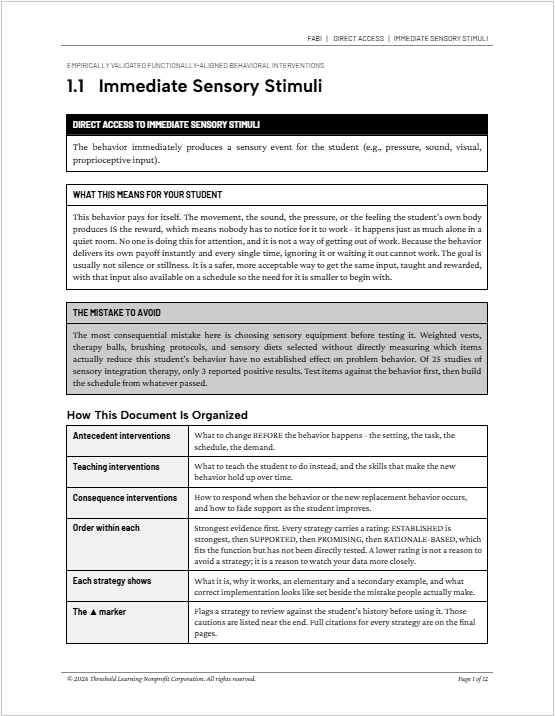
This set is built for the space between them. Intervention guides organized by function, and behavior intervention plan starters your team can build from immediately. They are the same tools our Navigators work from, formatted so your school team can use them the moment you buy them.
This set assumes the function is already known. If your team is still working out why a behavior is occurring, this will not answer that question and starting here would put you back in the position the second finding describes.
TLC Nonprofit is a 501c3 organization.
All donations are tax exempt.
People and Partnerships of The Navigators
-

Jordan Husa, MA
Reviews every referral, assigns cases, and is the person your district talks to throughout each case
PROGRAM DIRECTOR
-

Katie Graves, PhD
Reviews the analytic work for technical adequacy at each phase before it reaches your team.
EXPERT IN RESIDENCE
-

Rose Iovannone, PhD
Developer of the Technical Adequacy Tool for FBAs and University of South Florida research collective lead
RESEARCH PARTNER







The Navigators
Training License
Everything our Navigators are trained on, licensed for your own staff to use: the video training, the operational description and observation protocols, the data collection forms, the analysis routines, the report templates and the quality criteria we hold our own work to. Your team works through it and runs the process internally, on your timeline, across as many cases as you have.
This is the version of The Navigators where we are not in the room. For a district whose staff already have the knowledge and are mostly missing a structure to put it in, that tends to be exactly the right fit.
If you would rather have our eyes on your first several cases, the co-implemented evaluation below does that and it is where most districts choose to begin.
TLC Nonprofit is a 501c3 organization.
All donations are tax exempt.
FBA
Exemplar Audit
Send us five to ten of the best FBAs from your district, redacted. We score each one against the same technical adequacy tool we use on our own work, look at the patterns across the whole set and return a written report of what is consistently strong, what is consistently lagging, and where your local processes may be leaving you exposed.
Districts often use this before deciding whether they need outside evaluations at all. Some find their process is sound and the real gap is time. Others find something structural. Either answer is worth having before money goes toward the wrong solution.
This audit is made possible through a research partnership with the University of South Florida.
TLC Nonprofit is a 501c3 organization.
All donations are tax exempt.
Clarity Backed
by Expertise
-
It depends on whether you're bringing one case or planning for a year, and the comparison document at the bottom of this page lays out the three ways districts work with us. The short version: a single evaluation is fixed-scope and priced as such, bundles carry a preferred rate, and a capacity agreement reserves evaluation availability across a year. We'll give you a figure on the call once we know what fits your needs.
-
About twenty-five school days from kickoff. That's real elapsed time, not padding - observation across conditions and honest input from staff don't compress. It can run longer if data collection stalls. It cannot run shorter.
-
Tell us anyway, and tell us early. Sometimes there's a way to sequence things that works. Often there isn't, and we'll say so rather than produce something that won't hold up.
-
Complete the direct observations using forms we build, participate in interviews, attend two meetings, and enter data within the collection window. One person needs to be the designated contact.
-
You do. The completed FBA is your district's document, in your records, and the behavioral data stays with the district as part of the student's educational record. All research is conducted on deidentified data sets.
-
We email one month after a case closes and will schedule a brief conversation if you want one. The assessment itself doesn't change at that point, but we can talk through what's come up and what to adjust. If a plan isn't producing change, that's usually a question about implementation or about something that shifted in the setting, and both are worth talking through.
-
Usually, yes. We work inside your existing process rather than replacing it, which means your MTSS structure, your data systems, and your meeting schedule stay as they are wherever possible.
-
This is the question we get most often from districts not yet ready to refer a case, and using the TATE with your local team is the direct way to answer it.
Three ways to
work with The Navigators
Evaluate Package
A set of functional behavior assessments conducted across a semester or a school year, each one completed by an aspiring school-based behavior analyst and scored against the same technical adequacy standard. This is the right starting point when the need is sound assessment now and your team does not have the capacity to produce it.

Mentor Package
The same set of assessments, with one of your own staff working alongside us throughout each Navigated FBA. Your staff member does not need to be pursuing BCBA or IBA certification. The point is that someone in your district sees how each assessment is built and why it reached the conclusion it did so they can extend their expertise within your district.

Transfer Support
Ongoing consultation and case review added to either the Evaluate or Mentor package, so your team can bring evaluations of their own for a technical adequacy review. This is the option for districts whose goal is to stop referring out and increase their local capacity to produce technically adequate FBAs.

Book a Call
Most teams reach out when an evaluation timeline is already running. Tell us where the case stands, what has already been tried, and what data collection is realistic for your staff, and we will tell you honestly whether the timing works and whether this is the right fit.
Some of these conversations end with us saying the case needs something other than an evaluation, or that the timeline will not be feasible. We would rather say that now than try to produce something indefensible.
About thirty minutes. Bring one case you are stuck on. See you soon…
More from The Navigators

Be the first to know about what’s happening around TLC
Get a weekly update on current events, partnership spotlights, outreach efforts, Integros events, recent blogs, and more!
Your contribution supports The Navigators.
TLC Nonprofit is a registered 501c3 organization. All donations are tax exempt.